

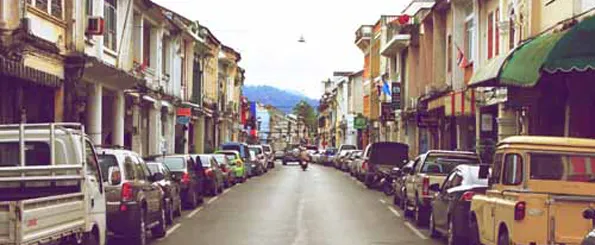
Phuket Old Town is known for its Sino Portuguese architecture: rows of pastel shophouses and grand mansions built from the late 1800s, when tin mining made Phuket rich and brought thousands of Chinese settlers. The style mixes Chinese shophouse plans with European columns, arches and shuttered windows, inspired by the colonial towns of Penang and Malacca. The best streets to see it are Thalang, Dibuk, Krabi, Phang Nga and the small lane of Soi Romanee, all within a 20 minute walk of each other.
What is Sino Portuguese architecture?
The name describes buildings that combine Chinese and European styles. In Phuket it came by way of Penang and Singapore, where Chinese merchants copied the colonial buildings they saw and added their own touches. Common features:
- Shophouses: narrow, long buildings with a shop on the ground floor and the family home above.
- The five foot way (ngo kha ki): a covered walkway along the front of the shophouses, shading people from sun and rain.
- European details: columns, arches, plaster mouldings and tall shuttered windows.
- Chinese details: carved doors, painted tiles, sky wells inside the house and lucky symbols over the entrance.
- Pastel colours, restored over the last 20 years.
Where to see it: a short walking route
- Thalang Road: the main street of shophouses, cafes and shops. On Sunday evenings it becomes the Lard Yai Walking Street market.
- Soi Romanee: a short, colourful lane off Thalang Road, the most photographed corner of the Old Town.
- Dibuk Road: quieter, with some of the best preserved shophouses.
- Krabi Road: home to Baan Chinpracha (1903) and the Thai Hua Museum, and the Phra Phitak Chyn Pracha Mansion, now a restaurant.
- Phang Nga Road: old trading houses and the historic On On Hotel building.
The full walk takes about 1 to 2 hours with stops. Go early in the morning or after 16:00 to avoid the midday heat.
Why Phuket has these buildings
From the mid 1800s Phuket was one of the world’s main sources of tin. Chinese workers, mostly Hokkien from southern China, came to work the mines, and the most successful became merchants and mine owners. They built homes and shops in the style they knew from Penang. Many married local women, and their descendants, the Peranakan or Baba, created the food, dress and customs still seen in Phuket Town. Learn more at the Thai Hua Museum and the Phuket Mining Museum, or read our page on Phuket history.
Tips for visiting
- Wear comfortable shoes and bring water.
- Respect private homes: many shophouses are still lived in.
- Try Phuket dishes such as mee hokkien, moo hong and dim sum breakfast in the Old Town cafes.
- Stay overnight to see the streets lit up at night. See our Phuket Town hotels.
- Finish with the view from Khao Rang Hill, 5 minutes away.
Events in the Old Town
The Old Town’s shophouses, mansions and courtyards are also used for private dinners, gala nights and themed corporate events. Planners such as Phuket Event Company list venues across the island, including heritage settings in town.
For dinner in the Old Town, Royd on Dibuk Road serves refined Southern Thai tasting menus.
Frequently asked questions
What is Sino Portuguese architecture?
A style that mixes Chinese shophouse design with European columns, arches and shuttered windows. In Phuket it was built by Chinese tin merchants from the late 1800s.
Where can I see Sino Portuguese buildings in Phuket?
In Phuket Old Town, on Thalang, Dibuk, Krabi and Phang Nga roads and on Soi Romanee.
Why is it called Sino Portuguese?
“Sino” means Chinese. The European side of the style was linked to the Portuguese and other colonial towns of the region, such as Malacca and Penang.
When is the Phuket Old Town Sunday market?
The Lard Yai Walking Street market runs on Thalang Road on Sunday evenings.
For a quirky collection of old Phuket objects, visit the Thavorn Hotel Museum on Rasada Road.