

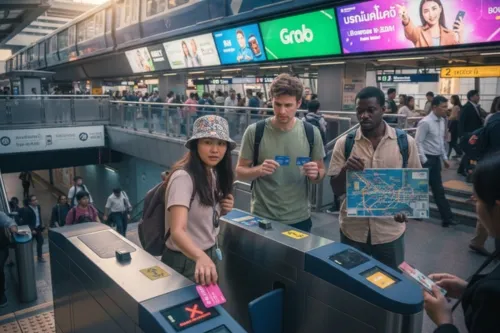
Bangkok MRT vs BTS: Which Card Works Where (2026)
On the Bangkok MRT you pay by tapping a contactless Visa, Mastercard or UnionPay card at the gate. Old MRT cards and MRT Plus cards stopped working on 1 June 2026. On the BTS Skytrain you need a Rabbit Card or a single journey ticket, because BTS gates do not take bank cards. So most visitors use two things: a contactless bank card for the MRT and a Rabbit Card for the BTS.
Quick answer: what to pay with
| Line | Pay with | Rabbit Card? |
|---|---|---|
| MRT Blue and Purple Lines (underground) | Contactless Visa, Mastercard or UnionPay card | No |
| MRT Yellow and Pink Lines (monorail) | Contactless bank card or Rabbit Card | Yes |
| BTS Skytrain (Sukhumvit and Silom Lines) | Rabbit Card or single journey ticket | Yes |
| Airport Rail Link | Ticket machines at each station | No |
Does the Bangkok MRT accept Apple Pay?
The MRT readers take contactless Visa, Mastercard and UnionPay credit cards, debit cards and prepaid cards. Phone wallets such as Apple Pay and Google Pay use the same card, so they generally work on the same readers. If your phone is refused, tap the physical card instead, and use the same card or phone to enter and exit so the system can work out your fare.
If a card is declined at the gate, the MRT operator asks you to contact your card issuer. Some foreign debit cards block contactless payments abroad until you switch them on in your banking app.
What changed on the MRT in June 2026
On 1 June 2026 the MRT moved fully to contactless bank card payment. The old blue MRT cards and MRT Plus cards can no longer be used for travel, and you can no longer top them up. If you have one, ask at an MRT ticket office about refunding the balance.
The Blue Line covers Chinatown (Wat Mangkon), the Grand Palace area (Sanam Chai), Sukhumvit, Silom and Bang Sue Grand Station. The Purple Line runs to Nonthaburi in the north west.
The BTS Skytrain and the Rabbit Card
The BTS runs above the streets through Siam, Sukhumvit, Thonglor, Silom and Sathorn, where most visitors stay, shop and go out. Its gates do not accept bank cards, so you need one of these:
- Rabbit Card. A stored value card you buy at any BTS ticket office with your passport. You load money onto it and tap in and out. You can top it up at the ticket office or in the My Rabbit app.
- Single journey ticket. Buy it from the machines or the ticket office for one trip. Keep it until you exit, as you need it to open the gate.
A joint fare across the BTS and MRT has been announced for 2027, but until it starts, treat the two systems as separate.
Changing between BTS and MRT
At interchange stations such as Asok and Sukhumvit, Sala Daeng and Si Lom, Mo Chit and Chatuchak Park, you leave one system and enter the other. Tap out of the BTS with your Rabbit Card, walk across, and tap into the MRT with your bank card. You pay two separate fares.
Tips for using Bangkok trains
- One card per person. You cannot tap two people through the gate with one card.
- Use the same card to exit. The fare depends on where you got on and off.
- Avoid rush hour (about 7:30 to 9:30 and 17:00 to 19:30) if you are carrying luggage.
- Plan your route in an app such as Google Maps, which shows BTS and MRT lines and changes.
- Keep small notes for the BTS ticket machines, which do not all take large notes.
Planning your trip
Bangkok trains reach most of the places in our pages on the best hotels in Bangkok, best restaurants in Bangkok and rooftop bars in Bangkok. Not sure how long to stay? Read how many days in Bangkok, or browse all our Bangkok posts.
Frequently asked questions
Can I use a credit card on the Bangkok BTS?
No. BTS gates do not take bank cards. Use a Rabbit Card or buy a single journey ticket.
Can I use a credit card on the Bangkok MRT?
Yes. Tap a contactless Visa, Mastercard or UnionPay card on the reader at the MRT gate.
Does the Rabbit Card work on the MRT?
Not on the Blue and Purple Lines. It works on the BTS and on the Yellow and Pink monorail lines.
Can I still use my old MRT card?
No. Old MRT cards and MRT Plus cards stopped working for travel on 1 June 2026.